Introduction
In business meetings today, technical buzzwords fly around constantly. "We need ML for sales forecasting," or "Let's use Deep Learning for image analysis," or "Why aren't we using GenAI for content?"
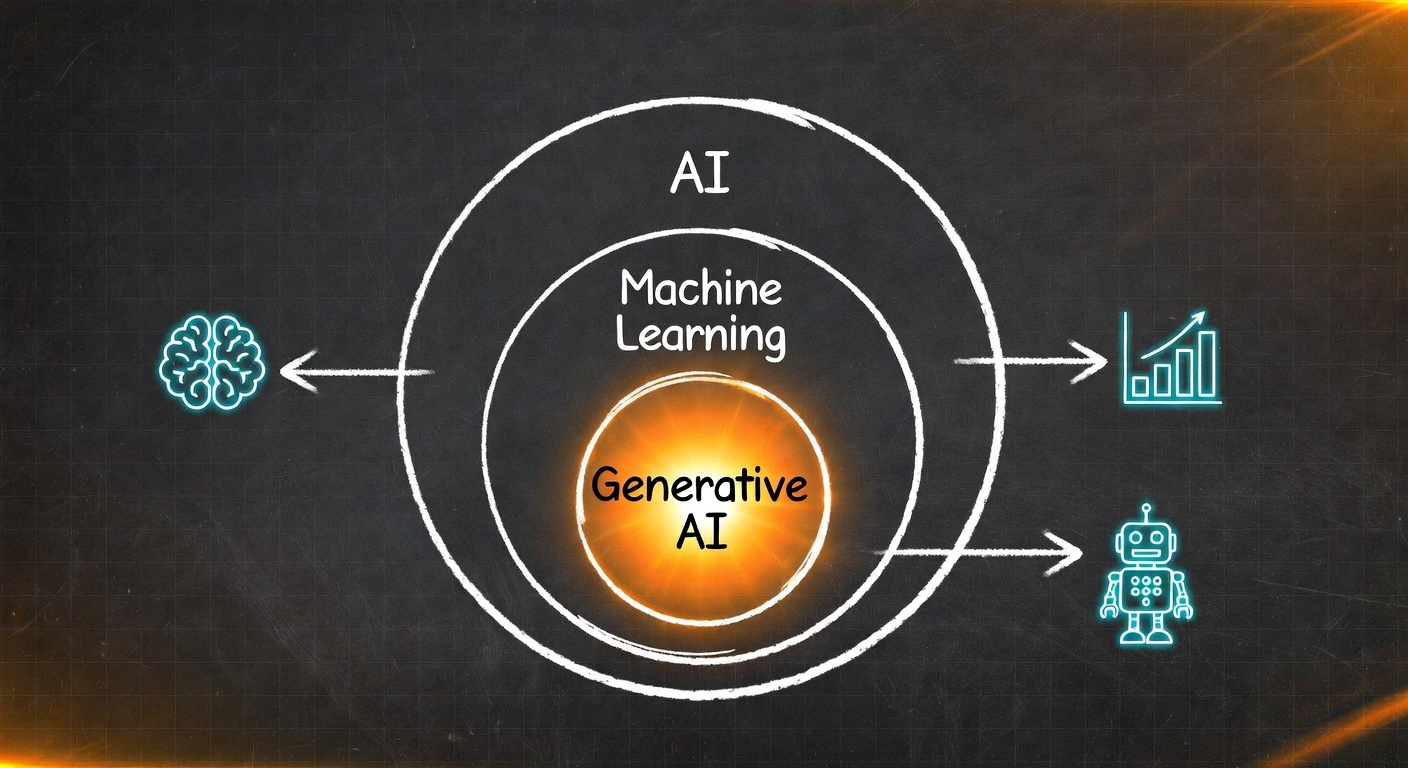
While these terms are related, they are not the same. To understand them clearly, think of them as a Matryoshka doll (Russian nesting doll) or concentric circles, where each one is a subset of the other.
1. Artificial Intelligence (AI) - The Big Umbrella
Definition: This is the broad discipline of creating intelligent machines capable of performing tasks that typically require human intelligence. This includes everything from simple rule-based logic to complex systems.
Example: Old-school chess computers, game bots with scripted paths.
2. Machine Learning (ML) - The Subset
Definition: A subset of AI where computers have the ability to "learn from data" without being explicitly programmed for every rule. The more data they process, the better they perform.
How it works: You feed input and output data into the system, and it figures out the rules or patterns by itself.
Use Cases:
- Netflix recommendation engine
- Stock price prediction (Predictive Analytics)
- Spam email filtering
3. Deep Learning (DL) - The Brain Mimic
Definition: A specialized subset of ML inspired by the structure of the human brain (Neural Networks). It uses multiple layers of processing to extract high-level features from data, making it excellent at handling unstructured data.
Use Cases:
- Facial Recognition systems
- Autonomous Vehicles
- Real-time translation (Google Translate)
4. Generative AI (GenAI) - The Creator
Definition: While traditional AI focuses on "analyzing" or "predicting" (Discriminative AI), GenAI is designed to "create" new content—be it text, images, audio, or code.
How it works: It leverages massive Deep Learning models to learn patterns and then synthesizes completely new outputs based on those patterns.
Use Cases:
- ChatGPT (Content writing/Reasoning)
- Midjourney (Art generation)
- GitHub Copilot (Code generation)
Comparison Cheat Sheet
| Technology | Primary Function | Example Use Case |
|---|---|---|
| Machine Learning | Predict outcomes from numbers/stats | Sales forecasting, Risk assessment |
| Deep Learning | Perceive images/audio/language | Object detection, Voice assistants |
| Generative AI | Create new content | Drafting emails, Designing logos, Coding |
Conclusion
Understanding these distinctions is crucial for strategy. If your goal is number crunching, Machine Learning is likely your answer. If it's creativity and drafting, Generative AI is the key.
Choosing the Right Tool for the Right Job is the first step in any successful AI initiative.